
 Admin
Admin
If you’ve ever found yourself staring at a jumble of words in the New York Times (NYT) Connections puzzle, you’re not alone. What seems like a simple task—grouping 16 words into 4 categories—can quickly transform into a mental maze. It’s no wonder so many puzzle enthusiasts turn to “Connections Hint Today Forbes” for support. This article will explore how the Forbes hint page has become an invaluable resource for those seeking to navigate the daily challenge of NYT Connections. From understanding why the puzzle feels trickier than it looks to how using hints can actually sharpen your puzzle-solving skills, we’ll break down the value of Connections Hint Today Forbes and why it’s become an essential part of the daily routine for many players.
Why NYT Connections Feels Harder Than It Looks
At its core, the NYT Connections puzzle is deceptively simple. Players are given 16 words and asked to sort them into 4 distinct categories. How hard can it be, right?
However, the challenge lies in the unpredictability of word associations. Words that should belong together often don’t, and a category you might feel confident about could be a clever trap set by the editors. The puzzle demands more than just knowledge; it requires lateral thinking. One must guess how the mind of the puzzle creator works, often incorporating cultural references, puns, or obscure wordplay.
Unlike traditional crossword puzzles, which focus on factual recall, Connections tests the player’s ability to think outside the box and interpret multiple meanings for words. And this is where Connections Hint Today Forbes steps in, offering helpful nudges without giving away the solution.
The Growing Popularity of Connections Hint Today Forbes
Not Just Another Answer Page
So, what makes Connections Hint Today Forbes so popular among players? One of the key factors is tone. Unlike other hint pages that provide direct answers, Forbes offers subtle suggestions designed to help players think critically about the puzzle’s structure without revealing the answer outright.
Rather than simply saying, “The answer is X,” Forbes hints encourage players to think about patterns and associations between words. This approach respects the puzzle and the player, keeping the challenge alive while still offering guidance.
A Hint System That Fits Into Daily Life
For many, puzzle-solving is part of a daily routine—often paired with morning coffee or a quick break from work. The Connections Hint Today Forbes page aligns perfectly with this rhythm. The hints are designed for skimming, pausing, and coming back to later, allowing users to approach the puzzle at their own pace. Whether you’re trying to break a losing streak or simply want a gentle nudge in the right direction, the flexibility of Forbes hints makes it a go-to reference.
This subtle, no-pressure format is one of the reasons players keep coming back. They don’t feel rushed or overwhelmed, and they can take their time, making the hinting system part of their routine rather than an interruption.
How Connections Hint Today Forbes Helps Players Get Unstuck
The Psychology of Puzzle Frustration
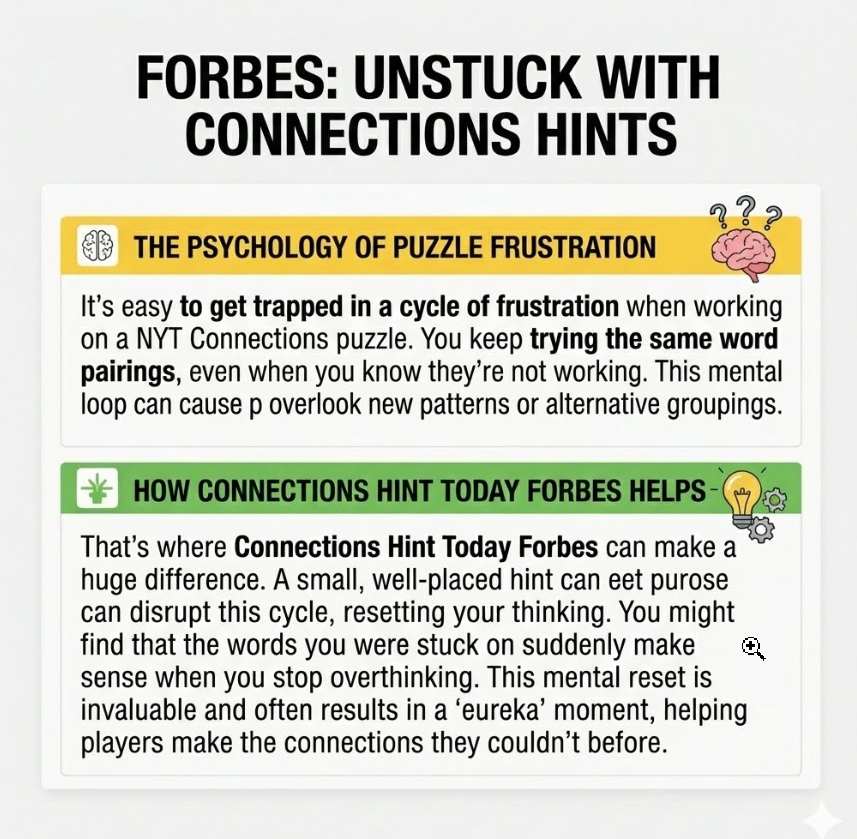
It’s easy to get trapped in a cycle of frustration when working on a NYT Connections puzzle. You keep trying the same word pairings, even when you know they’re not working. This mental loop can cause players to overlook new patterns or alternative groupings.
That’s where Connections Hint Today Forbes can make a huge difference. A small, well-placed hint can disrupt this cycle, resetting your thinking. You might find that the words you were stuck on suddenly make sense when you stop overthinking. This mental reset is invaluable and often results in a “eureka” moment, helping players make the connections they couldn’t before.
How to Use Connections Hint Today Forbes Without Losing the Fun
While it’s tempting to scroll straight to the answers, the key to maximizing the benefits of Connections Hint Today Forbes lies in using it sparingly. Here’s how to make the most of the hints without spoiling the experience:
1. Read Once, Then Walk Away
One effective strategy is to read just the first hint, then step away from the puzzle. Let the clue marinate in the background while you go about your day. Sometimes, a fresh perspective or an unrelated task can bring clarity to your puzzle-solving process.
2. Avoid Scrolling Too Quickly
It’s easy to get caught up in the temptation of scrolling for full answers, but this can kill the joy of solving the puzzle. Instead, treat the hints as a ladder—use only as many rungs as you need. This ensures that the challenge remains intact while still benefiting from a gentle nudge in the right direction.
3. Treat It Like a Conversation
Think of the hints as a conversation partner who’s guiding you through the puzzle—not dictating it. They’re not giving you the solution, but helping you see connections and patterns you might have missed. This relaxed mindset keeps the process enjoyable rather than frustrating.
Understanding How Connections Hint Today Forbes Improves Long-Term Puzzle Skills
The Educational Value of Hints
Over time, regularly reading Connections Hint Today Forbes helps you learn how the editor thinks. You’ll begin to notice recurring patterns—like homophones, suffixes, and shared contexts—rather than just shared definitions. This knowledge gradually sharpens your intuition for grouping words, making the puzzle easier in the long run.
In a way, using hints is like taking an educational shortcut. You’re learning by trial and error, and every hint offers insight into the editor’s mind and puzzle-building process. This long-term learning helps improve your puzzle-solving skills without making you feel reliant on external help.
Should Beginners Use Connections Hint Today Forbes?
While beginners should challenge themselves to solve the puzzle independently, hints can be incredibly helpful when you’re stuck. It’s important to build confidence and pattern recognition before turning to hints, but once you’re familiar with the puzzle’s structure, Connections Hint Today Forbes can provide useful insights without taking away from the experience.
For newcomers, it’s better to use hints as a last resort rather than a first step. This way, you get the satisfaction of solving the puzzle on your own while still benefiting from helpful guidance when necessary.
Common Pitfalls and Misconceptions About Using Hints
Is Using Hints Considered Cheating?
In the world of NYT Connections, most players don’t consider using hints to be cheating. Rather, hints are seen as a tool that helps guide your thinking. They’re not a shortcut to the solution, but a way to help you break through mental blocks. Think of them as a friendly nudge, not a shortcut to victory.
Can Hints Reduce Frustration Without Reducing Fun?
Absolutely. Used sparingly, hints can alleviate frustration and keep the fun intact. They help you feel more engaged with the puzzle, rather than giving up or getting stuck in an endless loop of frustration. By resetting your thinking, hints make the puzzle-solving process more enjoyable and rewarding.
Conclusion: The Balanced Approach to Puzzle Solving
At the end of the day, Connections Hint Today Forbes is not about finding shortcuts—it’s about enhancing the puzzle-solving experience. The right hints can nudge your brain in the right direction, help you break mental loops, and gradually sharpen your puzzle-solving skills. By using hints thoughtfully, you can enjoy the puzzle without feeling overwhelmed or stuck.
If you’re ready to step up your NYT Connections game, remember that hints are there to help, not to hand you the answers. Use them wisely, and you’ll start to see the puzzle in a new light, gaining skills that will make future puzzles easier and more enjoyable.
For More Update Visit: Fortunes